A Longer Life Is Not Necessarily a Healthier One.
For a long time, ageing has been discussed as a number: how many years we live. But adding years and protecting the quality of those years are not the same achievement.
Lifespan tells us how long a person lives. Healthspan asks how many of those years are lived with meaningful health, function and independence. That distinction sits at the centre of longevity medicine. The aim is not to promise immortality or pretend ageing can be stopped. It is to understand the factors shaping how we age and make better-informed decisions earlier.
It is a live question in Australia. According to the Australian Institute of Health and Welfare, people born in 2024 can expect to spend most — but not all — of their lives in full health, and the number of years lived in ill health has been slowly rising even as life expectancy has grown. In other words, we are adding years, but not always adding healthy years at the same pace.
Independent longevity consultations are now available from within SKYNN's Albion, Brisbane clinic — a separate medical pathway for people who want to explore this wider picture. This article explains the ideas behind it, and where skin genuinely fits.
Lifespan: The Number of Years.
Lifespan is the total number of years a person lives, from birth to death. It is the most familiar way we talk about ageing, and modern medicine has extended it dramatically — through vaccination, safer surgery, better management of chronic disease and countless other advances.
But lifespan is shaped by many interacting factors: genetics, environment, access to healthcare, socioeconomic circumstances, behaviour and disease among them. No individual can fully control or accurately predict their own lifespan. It is a useful population measure, not a personal guarantee.
Healthspan: The Quality Within Those Years.
Healthspan is the period of life spent in relatively good health and functional capacity — broadly, the years lived free from major chronic disease and significant physical or cognitive decline. There is no single agreed test or score for it; a recent systematic review found nearly two hundred different definitions in the research literature. But the common thread is consistent: healthspan is about function, not just survival.
Healthspan tends to be discussed across domains such as:
- Physical function and mobility
- Muscle and strength
- Metabolic health
- Cognitive function
- Energy and resilience
- Sleep and recovery
- The ability to participate meaningfully in everyday life
The World Health Organization frames healthy ageing in a related way — as developing and maintaining the functional ability that lets people be and do what they value. Importantly, that ability reflects both a person's intrinsic capacity and their environment, which is a reminder that healthspan is never purely a matter of individual willpower.
| Term | What it describes |
|---|---|
| Lifespan | How long a person lives. |
| Healthspan | How long a person maintains meaningful health and function. |
| Longevity medicine | A medically guided approach to understanding the factors that may influence long-term health and ageing. |
The Goal Is Not Simply More Time. It Is More Life Within It.
Ask most people what they want from ageing and the answer is rarely a number. It is the capacity to keep doing what matters: staying independent, staying strong, thinking clearly, moving freely, keeping their energy and their confidence, and staying connected to the people and activities they care about.
Two people can reach the same age and experience it entirely differently. Same lifespan. Very different healthspan.
This is why healthspan has become the more useful lens. It moves the conversation away from fear of ageing and toward something more practical: understanding what supports function over time, and asking better questions earlier — without guarantees, and without pretending ageing is a problem to be defeated.
Ageing Is a Whole-System Conversation.
No single factor determines how we age. Healthspan reflects the interaction of many systems over time. The areas below are widely discussed in healthy-ageing research — not as a checklist to self-diagnose, but as a map of what a medical conversation might consider.
Metabolic health
How the body regulates glucose, along with cardiovascular risk factors and body composition, can become increasingly relevant through adulthood. These are matters for individual medical assessment rather than self-diagnosis.
Muscle and strength
Muscle is not only an aesthetic consideration. It supports movement, stability, metabolic function and independence — and preserving it is closely tied to maintaining function later in life.
Sleep and recovery
Sleep supports a wide range of physiological and cognitive functions and influences how people feel, think and recover day to day.
Nutrition
Overall dietary patterns and nutritional adequacy matter more than any single food or supplement. There is no universal diet that suits every person, and nutrition is best considered individually.
Movement
Regular physical activity — including resistance exercise, cardiovascular fitness and mobility work — is one of the most consistently discussed contributors to healthy ageing.
Stress and emotional wellbeing
Long-term stress and psychological health are part of the broader health picture, not separate from it.
Hormonal and age-related change
Hormonal changes across adulthood may influence energy, sleep, body composition, skin and general wellbeing. But symptoms like these have multiple possible causes and require individual medical assessment — they cannot be assumed or self-diagnosed.
Preventative health
Appropriate screening and risk-factor assessment are matters for an individual and their healthcare practitioner. For context, the AIHW's most recent burden-of-disease analysis identifies conditions such as coronary heart disease and dementia among the leading contributors to ill health in Australia, with overweight and tobacco use among the most significant modifiable risk factors — a reminder that much of the health-ageing conversation is about prevention.
Skin Is Not Separate From Ageing. But It Is Not a Diagnostic Test for the Body.
This is where SKYNN's expertise sits — and where honesty matters most. Skin ageing is real, visible and meaningful, but it is not a window into your internal health in the way some marketing suggests.
Visible skin ageing reflects a combination of intrinsic biological ageing, cumulative UV exposure, collagen and elastin changes, hormonal change, barrier function, inflammation, sleep, stress, nutrition, smoking and environmental exposure, and a person's previous skincare and treatment history. That is a lot of inputs — which is exactly why skin should be assessed carefully rather than read like a health report.
The skin can reveal patterns and provide useful clinical information about its own structure and function. It cannot, by appearance alone, diagnose an internal medical condition.
What our dermal team can assess is the skin itself — thoroughly and clinically:
- Barrier integrity
- Pigmentation
- Vascular activity
- Inflammation and congestion
- Texture and scarring
- Collagen loss and laxity
- Treatment suitability and contraindications
- Healing and previous treatment response
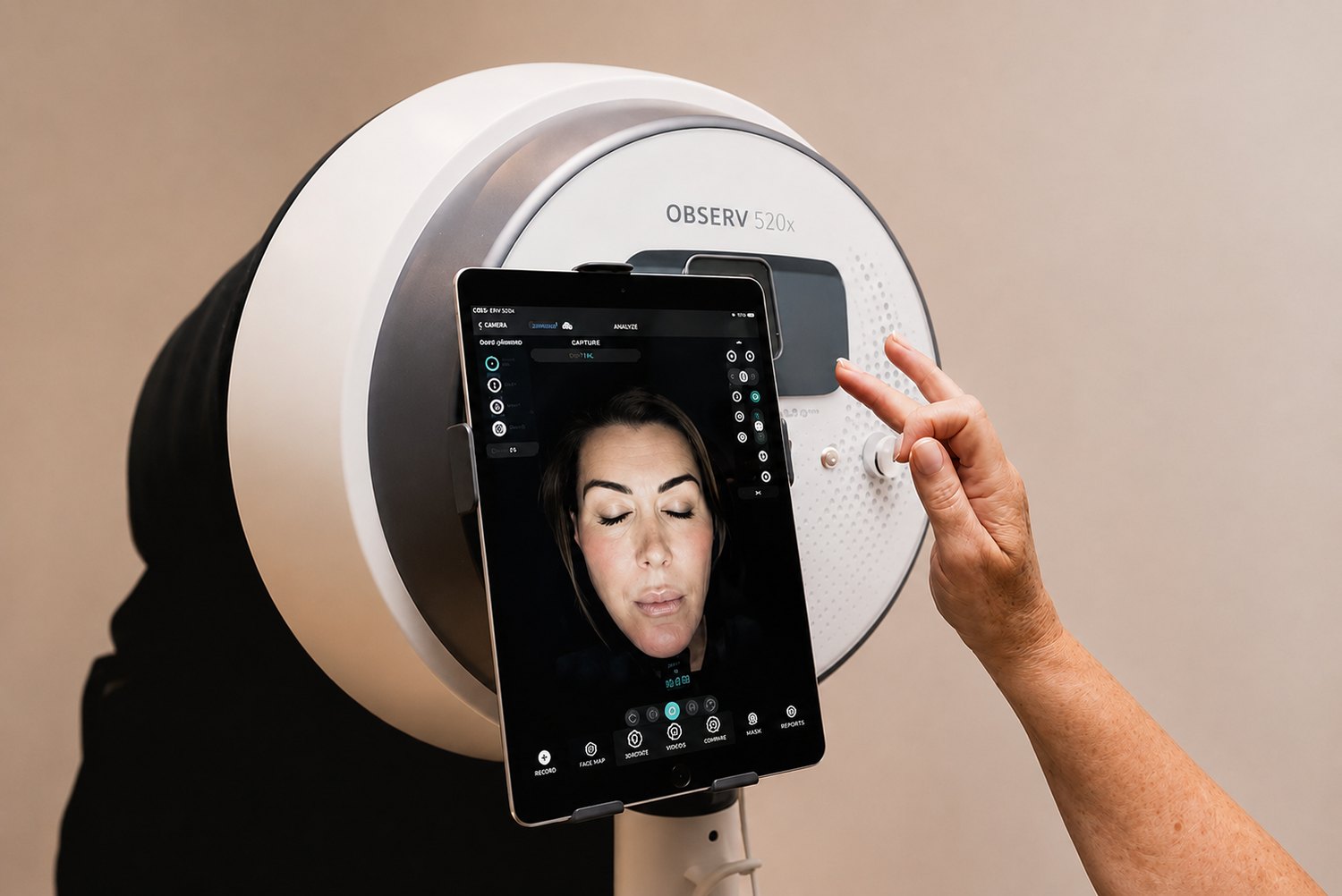
Our assessment uses tools including Observe 520X skin imaging to examine the skin's structure and function in detail. That imaging informs skin analysis and treatment planning — it does not diagnose systemic disease. If your primary concern is your skin, that is exactly what an Advanced SKYNN Consultation is designed to assess.
In Brisbane, UV Belongs in Every Ageing Conversation.
Brisbane and Queensland sit under some of the highest UV levels in the world. Through summer, Brisbane's daily maximum UV Index frequently averages in the extreme range, and Australia's environmental radiation agency notes unprotected skin can be damaged in as little as around fifteen minutes when UV is at its peak.
That environment leaves a visible mark over time. Cumulative sun exposure contributes to collagen degradation, pigmentation and uneven tone, vascular change, texture changes and reduced elasticity — and Cancer Council evidence notes the association between lifetime sun exposure and both hyperpigmentation and wrinkling is particularly strong in people under fifty. The everyday, incidental exposure often matters as much as the obvious sunburns.
Living in Brisbane does not create one universal skin type. It creates a significant environmental pressure that interacts differently with every person's pigment response, barrier, genetics, lifestyle and treatment history.
This is one reason a considered approach to visible skin ageing matters locally — not because everyone's skin is the same, but because the environmental pressure here is real and worth assessing individually.
Two Professional Lenses. Two Different Questions.
One of the most useful things to understand is that a dermal assessment and a medical assessment answer different questions. They are complementary, but they are not the same, and they are delivered by different professionals.
| Advanced SKYNN Consultation | Longevity Medical Consultation |
|---|---|
| Provided by the SKYNN dermal team | Provided by an independent AHPRA-registered practitioner |
| Focused on the skin | Focused on the wider medical picture |
| Clinical skin history and assessment | Medical and family history |
| Observe 520X imaging | Discussion of symptoms and health priorities |
| Skin function and concern analysis | Consideration of further investigation where appropriate |
| Dermal treatment suitability and Skin Blueprint planning | Medical diagnosis and recommendations, managed by the practitioner |
| Booked through SKYNN | Arranged through the longevity enquiry page |
These services are professionally distinct. A client may choose either service independently, and booking one does not require or guarantee treatment through the other.
Not Immortality. Not Internet Biohacking. Not a Universal Protocol.
Responsible longevity medicine is quieter and more individual than the online conversation suggests. It begins with a medical conversation — considering your medical and family history, exploring relevant symptoms and priorities, and possibly looking at lifestyle factors. It may involve appropriate investigation, sets realistic goals, and recognises that recommendations differ from person to person.
Importantly, it does not guarantee a particular diagnosis, test, treatment or prescription. Anyone promising a fixed protocol, a universal solution or a way to reverse ageing is describing marketing, not medicine.
You Do Not Need to Wait Until Something Is Wrong to Ask Better Questions.
People who explore a longevity consultation often include those who:
- Want a more considered approach to healthy ageing
- Have noticed changes in energy, sleep or recovery
- Want to discuss weight or body-composition changes medically
- Want to preserve strength and function as they age
- Have questions about age-related change
- Want medical guidance rather than online trends
- Want to establish realistic long-term health priorities
These concerns have many possible explanations. A longevity consultation does not guarantee a diagnosis, investigation, prescription or particular treatment.
Longevity Consultations in Albion, Brisbane.
Independent AHPRA-registered medical practitioners consult from within the Albion clinic, in Brisbane's inner north — easily accessible from Newstead, Hamilton, Ascot, Clayfield, Windsor, Newmarket, Fortitude Valley and the surrounding inner-north suburbs. The medical service is delivered independently; SKYNN provides the dermal side of the picture.
Explore independent longevity consultations in Brisbane to understand the process, suitability and how to enquire.
Which Pathway Should I Choose?
Advanced SKYNN Consultation
- Skin imaging
- Clinical dermal assessment
- Personalised Skin Blueprint
- Treatment planning
Longevity Medical Consultation
- Doctor-led medical assessment
- Healthy-ageing priorities
- Relevant symptoms and history
- Consideration of next steps
Common Questions.
What is the difference between lifespan and healthspan?+
Lifespan is the total number of years a person lives. Healthspan is the portion of those years spent in relatively good health and function — free from major chronic disease and significant physical or cognitive decline. Living longer and living well for longer are related, but not the same.
What is longevity medicine?+
A medically guided approach to understanding the factors that may influence long-term health and how a person ages. It does not promise to stop ageing. It focuses on individual medical history, relevant symptoms and priorities, and considers where further assessment may be appropriate.
Can skin show how healthy I am?+
Skin can reveal useful clinical information about its own structure and function — barrier, pigmentation, vascular activity, texture and collagen change. It cannot, by appearance alone, diagnose an internal medical condition. Skin is one part of the ageing picture, not a diagnostic test for the body.
Is a longevity consultation the same as a SKYNN skin consultation?+
No. They are professionally distinct. An Advanced SKYNN Consultation is a skin-specific, diagnostic-led assessment provided by the SKYNN dermal team. A Longevity Medical Consultation is a separate medical service provided independently by an AHPRA-registered practitioner. Booking one does not require or guarantee the other.
Do I need an existing medical condition?+
No. Many people explore a longevity consultation to ask better questions about healthy ageing, not because something is wrong. These concerns have many possible explanations, and a consultation does not guarantee a diagnosis, investigation or particular treatment.
Can I discuss changes in energy, sleep, weight or body composition?+
Yes. These are common reasons people seek a medical conversation about healthy ageing. Symptoms like these have multiple possible causes and are assessed individually by the practitioner.
Will I be prescribed medication?+
A consultation does not guarantee that medication will be prescribed. The practitioner first considers your medical history, current health, goals and clinical suitability. Any recommendation is made individually and only where considered medically appropriate.
Where are the longevity consultations located?+
Independent AHPRA-registered medical practitioners consult from within the Albion clinic in Brisbane's inner north, easily accessible from Newstead, Hamilton, Ascot, Clayfield, Windsor, Newmarket and Fortitude Valley.
How do I enquire?+
You can enquire about an independent longevity medical consultation through the longevity service page. Skin-specific concerns are booked separately through the Advanced SKYNN Consultation.
Ageing Well Begins With Understanding What Matters Now.
Longevity is not a promise to escape ageing. It is a more considered way of participating in it — understanding the factors that influence how we feel, function and live, then making decisions with greater clarity.
At SKYNN, that philosophy begins with the skin but does not pretend the skin is the whole story. For skin-specific concerns, our dermal team provides advanced clinical assessment and treatment planning. For the wider medical picture, independent longevity consultations are now available from within our Albion clinic.
Different questions. Different professional lenses. One more informed place to begin.
Sources
Australian Institute of Health and Welfare — Australian Burden of Disease Study 2024 (health-adjusted life expectancy; leading causes of burden; risk factors).
World Health Organization — Healthy Ageing and the functional-ability framework.
Australian Radiation Protection and Nuclear Safety Agency (ARPANSA) — Sun exposure, UV Index and Brisbane UV data.
Cancer Council Australia — UV radiation, sun exposure and associations with skin ageing.
Peer-reviewed reviews on definitions of healthspan (systematic review literature indexed in PubMed).
This article is general information about healthy ageing and is not medical advice. It does not diagnose any condition or recommend any specific treatment. Longevity medical consultations are provided independently by AHPRA-registered practitioners. For advice about your own health, speak with a qualified healthcare professional.