Every year the aesthetics industry produces new devices, new actives and new trends. Very few of them genuinely change how we think about treating skin. Spicule technology is one of the few that does — and it is worth understanding properly, rather than through a marketing lens.
At SKYNN, we are cautious by nature. We don't adopt a treatment because it is trending, and we don't recommend anything until we understand exactly how it works and who it genuinely helps. Bio-spicule therapy earned its place in our clinic because the mechanism is sound, the results are visible, and it solves a problem that has quietly limited skincare for decades: getting active ingredients where they actually need to go.
This guide explains what bio-spicules are, how the technology works, what it can and can't do, and how our standalone Idenel spicule treatments differ from the elevated Glassifier™ Skin Regeneration Facial. As with everything we publish, the goal is understanding — not persuasion.
What Are Bio-Spicules?
Bio-spicules are microscopic, crystalline structures suspended within a professional treatment serum. They are not attached to a device and there is no needling instrument involved — they are massaged into the skin by hand, as part of the serum itself.
The system we work with at SKYNN is Idenel, a Korean biotechnology house focused specifically on the science of transdermal delivery. At the core of their patented Altum™ Peptide Technology are RaphiTox™ bio-microneedles: ultra-fine spicules derived from purified marine sponges, measuring roughly 200–300 microns, bonded directly to high-performance peptides.
On contact with the skin, these structures create temporary microchannels and release their bound peptides into the deeper layers. That does two things at once: it signals the skin to begin its own renewal response, and it carries active ingredients somewhere they could not otherwise reach.
This is why the category is described as bio-microneedling rather than needling. It is not exfoliation, and it is not traditional microneedling. There is no trauma, no blood and no numbing required — which is precisely what makes it suitable for skins where more aggressive intervention is contraindicated.
Why Ingredient Delivery Is the Real Problem
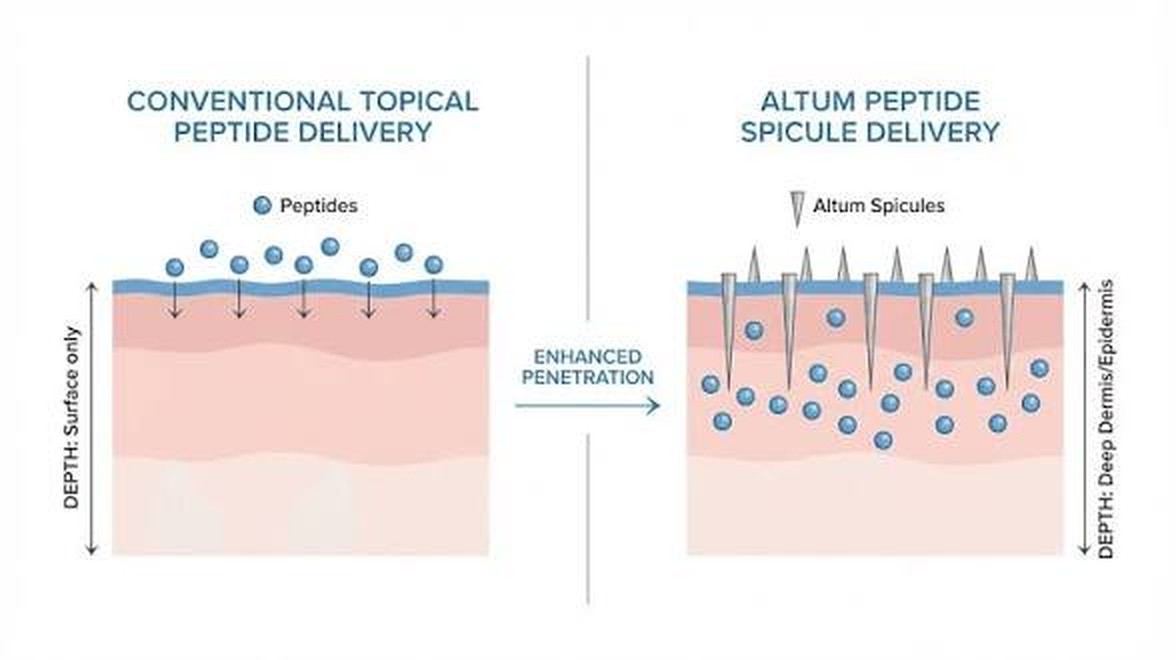
One of the most persistent frustrations in skincare is that many of the most valuable active ingredients simply don't penetrate. The skin's outermost layer — the stratum corneum — exists precisely to keep things out. It does its job well. The result is that a great deal of what people apply, and pay for, never reaches the living cells where it could make a difference.
This is the specific problem spicule technology is designed to solve. By creating temporary microscopic pathways, bio-spicules allow actives to interact with the deeper, living layers of the skin rather than resting uselessly on top. In the Idenel system, the peptides are bonded directly to the spicules and released once inside the skin — a delivery mechanism designed to keep the ingredients stable until they reach their target.
Idenel reports that this approach delivers bound peptides up to 60× deeper than standard topical application achieves, with the majority of peptide release occurring within the first 24 hours. Their platform has been assessed by third-party testing at the Korean Research Institute of Dermatology, which recorded measurable improvements in skin elasticity, density and wrinkle depth over a six-week period.
The kinds of ingredients that benefit most from this enhanced delivery include:
- Peptides, including copper peptides such as GHK-Cu, which support collagen signalling and repair
- Glutathione, a brightening antioxidant that is notoriously difficult to deliver topically
- Regenerative complexes such as PDRN, associated with tissue repair and skin quality
- Brightening and tone-correcting actives
- Hydrating and barrier-supporting ingredients
The point is not that these ingredients are new. It's that spicule delivery gives them a genuine route into the skin — which is a very different proposition from a serum that stops at the surface.
The problem was never the ingredients. It was getting them past a barrier designed to keep everything out.
How Bio-Spicules Stimulate Regeneration
Skin renewal is driven by signalling. Where traditional needling relies on controlled micro-injury to trigger a wound-healing cascade, spicule therapy works differently: the microchannels are transient and non-traumatic, and the regenerative response is driven largely by what gets delivered through them.
As the bound peptides release into the deeper layers, several things follow: improved cellular communication, healthier turnover, fibroblast activation and collagen synthesis over time, and a general improvement in skin resilience and texture. Idenel reports continued stimulation of this regenerative response for up to 72 hours after a single treatment — meaning the work continues long after you leave the room.
It's worth being honest about the timeline. Collagen synthesis is not instant. Fibroblasts stimulated during a treatment continue producing new collagen for weeks afterward, which is why spicule treatments are best understood as a series with appropriate spacing between sessions — not a single event. Treating too aggressively or too frequently works against the very process you're trying to support.
What Bio-Spicule Therapy Can Help Improve
Because it works by supporting regeneration and delivery, spicule therapy can be incorporated into plans for a range of concerns. It is rarely the whole answer on its own — but as part of a considered program, it earns its place.
Dullness and Loss of Glow
This is often the most immediate, visible benefit. Improved cellular turnover and deeper hydration tend to leave the skin looking fresher, brighter and more light-reflective — the quality people describe as "glass skin."
Uneven Tone and Pigmentation
Healthy turnover plays an important role in improving dullness and uneven pigment. Paired with brightening actives such as glutathione, spicule delivery can support a more even complexion — though pigmentation in our climate always needs a broader strategy, which we cover in our pigmentation guide.
Fine Lines and Early Ageing
Collagen declines with age. Treatments that support collagen production and renewal can help soften the appearance of fine lines and improve overall texture, particularly as part of an ongoing program.
Congested and Acne-Prone Skin
Improved turnover and healthier skin function can support congested skin as part of a personalised plan. It is a complement to proper acne treatment, not a replacement for addressing the underlying cause.
Enlarged Pores and Texture
As skin quality improves and collagen builds, many people notice a refinement in the appearance of pores and a smoother overall surface.
Bio-Spicules vs Skin Needling
The question we're asked most often is whether bio-spicule therapy is the same as skin needling. It isn't. Both prompt a regenerative response, but they arrive there by different routes — one through controlled micro-injury, the other through delivery.
| Bio-Spicule Therapy | Skin Needling | |
|---|---|---|
| Mechanism | Marine-sponge spicules within a serum, massaged in by hand | A device with sterile needles creating mechanical channels |
| Primary strength | Deep ingredient delivery and regenerative signalling | Collagen induction at depth |
| Best for | Radiance, tone, hydration, overall skin quality | Collagen building, scarring, deeper remodelling |
| Trauma | None — no blood, no numbing | Controlled micro-injury; numbing typically used |
| Downtime | None | Varies with needle depth |
| Sensitive skin | Often suitable, including rosacea-prone | Frequently contraindicated |
Neither is "better." They do different jobs, and for some skins they work beautifully together within a longer plan. If you want the full picture on collagen induction, our skin needling guide and Dermapen explainer go deeper.
Two Ways to Treat: Standalone vs Signature
At SKYNN, spicule technology is offered two ways — and the distinction matters, because they suit different people and different goals.
Idenel Spicule Bio-Microneedling
Our standalone spicule treatments are the technology in its purest form. Cleansed skin, thorough assessment, an honest conversation about the day's objective. The spicules are applied and massaged into the skin with practiced precision, and the bound peptides, antioxidants and targeted actives follow — each one travelling deeper than it otherwise could.
The Peptaxel concentrates are colour-coded to different concerns — brightening, regeneration, anti-ageing, congestion — and the combination is selected to match your skin rather than a fixed menu item. Peptide release continues well beyond the appointment itself, with stimulation of the skin's regenerative response reported for up to 72 hours afterward.
These sessions are efficient, effective, and well suited to clients maintaining results or working through a treatment series. You can read the full protocol on our Idenel spicule bio-microneedling page.
The Glassifier™ Skin Regeneration Facial
The Glassifier™ Skin Regeneration Facial is our elevated Signature Treatment, built on the same Idenel spicule platform but layered with additional modalities that work with the delivery mechanism rather than alongside it. It is designed for one outcome: exceptional luminosity, hydration and skin vitality — the quality people describe as glass skin.
The sequence is deliberate. Oxygenating lymphatic therapy opens the treatment, decongesting the tissue and preparing the skin to receive. The marine bio-spicules are then applied, creating the temporary microchannels that make everything after them possible. A customised infusion of peptides, antioxidants and skin-replenishing actives is selected to your skin and delivered through those channels. Sonophoresis follows, using ultrasound to drive those actives further through the pathways the spicules have already opened. LED light therapy finishes the treatment, supporting cellular healing and calming inflammation.
These are not two versions of the same step. The spicules open the door; sonophoresis drives what follows through it. One creates the pathway, the other maximises what travels down it — which is why the sequence produces more than either modality achieves alone.
The Glassifier™ Skin Regeneration Facial runs for 75 minutes and is priced at $499. It works beautifully as a standalone treatment before an event or a season, and equally well as the premium tier within a longer program.
No blood. No numbing. No downtime. Because there is no mechanical trauma, spicule therapy is suitable for nearly every skin type — including sensitive and rosacea-prone skin, where conventional microneedling is contraindicated.
That is not a marketing claim about comfort. It is a genuine clinical difference in mechanism, and it widens who we can safely treat.
Why This Technology Is Getting Attention
The interest in spicule technology isn't only about the results. It's about what the mechanism represents: a shift toward treatments that support the skin's own biology — renewal and delivery working together — rather than forcing a single outcome.
Respected aesthetic educator Dr. Anil Rajani is among the practitioners who have spotlighted spicule technology as an exciting development in regenerative skincare, precisely because of this dual action. That kind of attention from experienced clinicians is worth noting — though, as always, the right question is not "is this popular?" but "is this right for my skin?"
The most exciting advances aren't the ones that force change. They're the ones that help the skin do its own work better.
The SKYNN Approach
We don't offer one-size-fits-all treatments, and spicule therapy is no exception. Every skin journey with us begins with an Advanced SKYNN Consultation, where we assess your skin health, barrier function, inflammation, hydration, pigmentation and goals — and only then determine whether spicule therapy suits you, and in what combination.
Sometimes the answer is yes, as a standalone treatment. Sometimes it becomes part of a larger plan. And sometimes another approach serves you better first. That honesty is the whole point — it's the foundation of The SKYNN Method, and it's why our clients trust the recommendations we make.